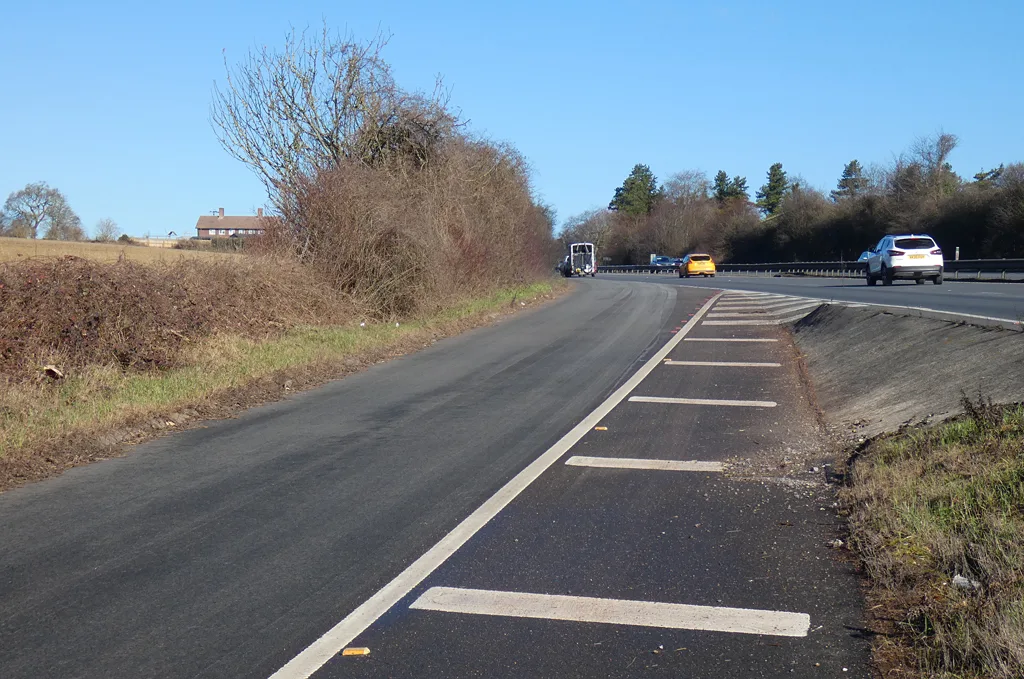

National Highways' A34 safety study will not support major work at East Ilsley and Beedon, MP Lee Dillon says. A near-miss camera study still needs funding.
Updated 26 November: after a second meeting, Lee Dillon says the near-miss camera study has not yet been commissioned because of funding, and National Highways is still considering signs, road studs and markings.
The A34 slip roads at East Ilsley and Beedon will not get the major safety scheme local campaigners wanted, at least for now. National Highways has told Newbury MP Lee Dillon that its long-awaited safety study cannot support the investment.
Mr Dillon set out the outcome on his website on Thursday 5 November. He called it “deeply disappointing”.
Beedon is about seven miles north of Newbury on the A34, and East Ilsley about nine. At both, slip roads join the dual carriageway.
What National Highways found
The study has not been published. Mr Dillon says it is “very nearly complete”, and he gave its main findings after meeting National Highways the week before.
According to his account:
- the main test for a major safety scheme is the number of people killed or seriously injured
- in the five years to the end of 2024, those figures at Beedon and East Ilsley were low compared with other places competing for the same funding
- collisions were spread along the A34, rather than concentrated around the slip roads
- taken with the cost of major work, such as lengthening the slip roads, that does not make “a strong enough case for the investment right now”
On the casualty figure, Mr Dillon wrote that there were “very sadly six at both Beedon and East Isley”. His post does not make clear whether that means six at each junction or six across the two.
What happens next
The study covers East Ilsley and Beedon, and Chieveley was added to it after further pressure from MPs. Mr Dillon says two things are still in play.
A “conflict study” is proposed, using cameras around the clock at the junctions and slip roads to record near misses, which do not show up in casualty figures. Mr Dillon’s 5 November post described it as a nine-day study. By 25 November it had not been commissioned: he wrote that “funding remains a challenge” and that National Highways “is now looking at how the study could be commissioned and carried out”.
Lower-cost measures also remain possible. Mr Dillon lists “effective signage, road markings, and other operational improvements”.
He met National Highways again in November. In a post on 25 November he wrote that it “reiterated that the number and spread of recorded collisions do not currently make the case for major engineering works”.
At that meeting he raised:
- clearer signage, LED road studs and better road markings, which National Highways “is continuing to consider”
- variable speed limits like those on the M4, although National Highways “has not identified evidence linking speed to the collisions recorded in the Safety Study”
National Highways is due to update him on the conflict study “in the coming weeks”.
Why it has taken so long
Mr Dillon has worked with neighbouring MPs from other parties on the A34 for more than a year. He has written to and met National Highways several times, asked parliamentary questions and run a constituency survey on A34 safety.
In his post he describes the junctions as “known high-risk areas with poor visibility, lane management, and a lack of speed enforcement measures”. He adds: “Just because these experiences don’t always show up in the most serious collision statistics, doesn’t mean they should be disregarded.”
What it means for you
If you use these junctions: nothing changes on the road yet. No new signs, markings or speed limits have been announced.
For live closures and roadworks on the A34: see our Newbury roadworks and travel page, updated each week.
We will report the study’s findings in full when National Highways publishes them.
Have your say