
No West Berkshire monitoring site broke the legal limit for nitrogen dioxide in 2025. Greenham Road in Newbury was highest, and 14 of 22 sites rose on 2024.
Every one of West Berkshire’s 22 roadside monitoring sites stayed under the legal limit for nitrogen dioxide in 2025. The highest reading was on Greenham Road in Newbury, at well under two thirds of the limit.
But the trend turned. Readings went up at 14 of the 22 sites compared with 2024, after a year when only one site rose. The figures are in an air quality report going to the Joint Public Protection Committee on Monday 7 December.
Overview
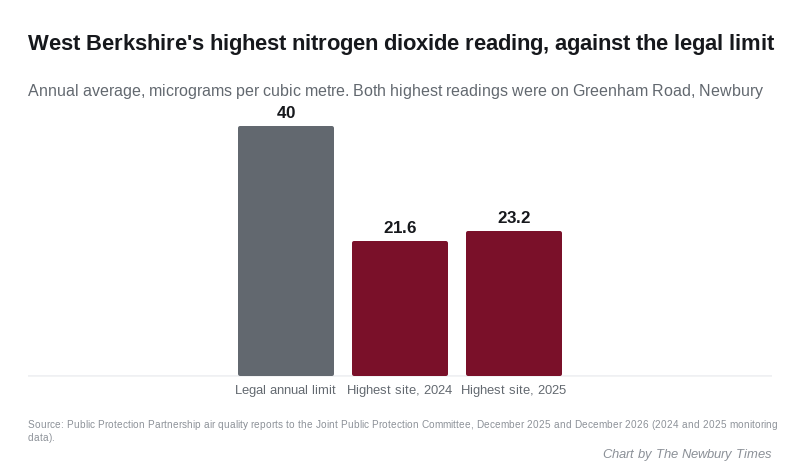
- Legal limit: an annual average of 40 micrograms of nitrogen dioxide per cubic metre (µg/m³).
- Highest reading in 2025: 23.2 µg/m³ at 1 Winchester Court, Greenham Road, Newbury.
- Highest reading in 2024: 21.6 µg/m³, also on the A339 Greenham Road.
- Direction: 14 of 22 sites rose on 2024, but levels are still lower than before the pandemic.
- Air quality zones: none. Newbury’s and Thatcham’s were both lifted in 2024.
What the 2025 figures show
The council measures nitrogen dioxide with small diffusion tubes fixed beside roads. Road traffic is the main source, especially on the A339 and the A4, the report says. Nitrogen dioxide is the main pollutant of concern in Newbury and Thatcham.
The worst spot, 1 Winchester Court, sits on Greenham Road inside the old Newbury air quality management area around St John’s Roundabout. Its 23.2 µg/m³ compares with the limit of 40. Defra’s appraisal letter on the same data gives the figure as 23.3.
No site came near the separate short-term limit either. That one allows no more than 18 hours a year above 200 µg/m³, and it was not broken in 2025, the report says.
A year of rises after years of falls
A year earlier the picture was steadier. In 2024 only one of 23 sites went up: 75 Chapel Street in Thatcham, from 18.0 to 19.1 µg/m³, the December 2025 report said. That year’s highest reading was 21.6 µg/m³ on Greenham Road.
The 2026 report does not say which 14 sites rose in 2025, or by how much. It says levels across the district have still fallen over the five years to 2025, and remain below where they were before the pandemic in 2019.
No more air quality zones, and no live monitor
West Berkshire once had two air quality management areas, on the A4 in Thatcham and around the A339 and St John’s Roundabout in Newbury. Both were revoked in 2024 after readings stayed under the limit.
Two things changed after that:
- The automatic monitor was switched off in 2024, “following AQMA revocation and funding constraints”, Defra’s letter says. The council now relies on the diffusion tubes.
- Government grant for the work stopped. The partnership received Defra grant funding up to 2023, but that stream ended in 2024, the report says. Monitoring is now paid for from the service’s own budget.
Defra accepted the council’s conclusions. It asked future reports to say more about fine particles (PM2.5), how measures link to results, and what risks such as funding could hold the work back.
What the council says it is doing
The report lists the measures the council counts towards cleaner air. They include:
- more than 600 new electric vehicle charge points with Connected Kerb, in a £382,000 programme
- School Streets schemes near three primary schools in Calcot, Thatcham and Tilehurst
- 21 new bus shelters in 2025, 11 of them with green roofs
- signs steering lorries onto the A34 bypass rather than through Newbury
A local air quality strategy is being written, Defra’s letter notes. Councils without an air quality zone are encouraged to have one.
What it means for you
If you live or walk beside the A339 in Newbury, the air there was the dirtiest measured in the district in 2025, but it was still well inside the legal limit.
The limit is not the same as a safe level. The report notes that poor air quality is still the largest environmental risk to public health in the UK. It says the young, the elderly, pregnant women and people with health conditions are most at risk.
The committee meets at 7pm on Monday 7 December. The papers are on the council’s meeting page.
Have your say